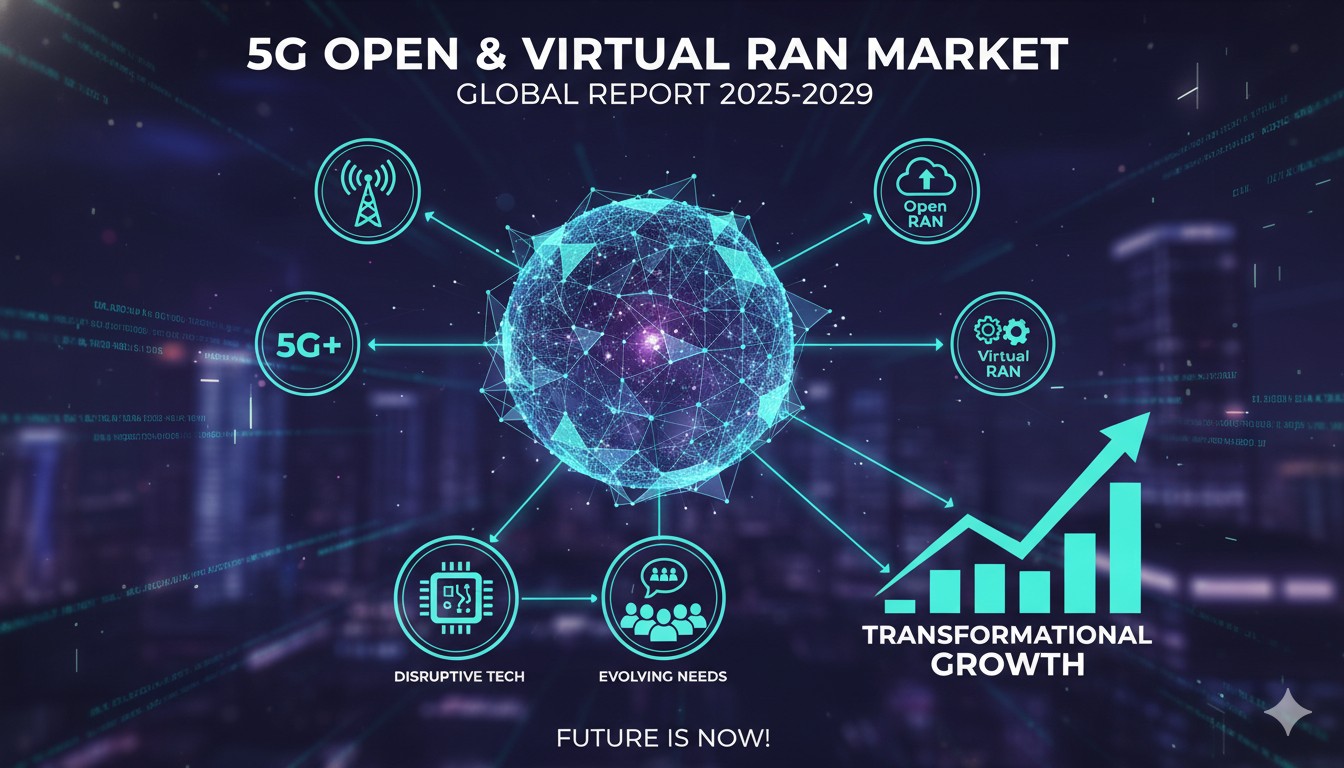
“The global 5G Open and Virtual RAN market is set to expand from approximately USD 4.7 billion in 2025 to over USD 20 billion by 2029, achieving a CAGR of around 39%, fueled by virtualization trends, AI integration, cost efficiencies, and surging demand for flexible network architectures amid widespread 5G deployments.”
Market Dynamics and Projections
The 5G Open and Virtual RAN sector is witnessing accelerated adoption as communication service providers pivot toward disaggregated architectures that break away from traditional vendor-locked systems. Open RAN, which emphasizes interoperability through standardized interfaces, allows operators to mix hardware and software from multiple suppliers, slashing capital expenditures by up to 40% in some deployments. Virtual RAN complements this by leveraging cloud-native platforms, enabling dynamic resource allocation and scalability that aligns with fluctuating data demands.
Projections indicate robust growth, with the market valued at roughly USD 4.7 billion in 2025, climbing to USD 8.5 billion by 2026, USD 12.3 billion in 2027, USD 15.9 billion in 2028, and surpassing USD 20 billion by 2029. This trajectory reflects a compound annual growth rate exceeding 39%, outpacing broader telecom infrastructure segments. Investments in Open RAN alone are expected to surge from USD 2 billion annually in recent years to USD 11 billion by 2029, driven by operator spending on AI-optimized networks to handle escalating cellular data volumes, projected to more than double over the period.
Key segments within the market include hardware components like radio units and baseband units, software for orchestration and management, and services encompassing integration and maintenance. Hardware holds about 45% market share in 2025, but software and services are gaining ground, expected to collectively reach 60% by 2029 as virtualization matures.
Disruptive Technologies Fueling Expansion
| Year | Market Size (USD Billion) | YoY Growth (%) | Key Contributors to Growth |
|---|---|---|---|
| 2025 | 4.7 | – | Initial 5G rollouts and vendor diversification |
| 2026 | 8.5 | 80.9 | AI traffic steering and cloud adoption |
| 2027 | 12.3 | 44.7 | Expansion in urban densification |
| 2028 | 15.9 | 29.3 | Rural connectivity initiatives |
| 2029 | 20.9 | 31.4 | Maturity of Open RAN ecosystems |
Advancements in AI and machine learning are transforming RAN operations, enabling predictive maintenance and automated traffic steering that optimize spectrum usage. For instance, AI-driven algorithms can reroute data in real-time, reducing latency to under 1 millisecond for critical applications like autonomous vehicles and industrial IoT. Cloud-native architectures, supported by hyperscalers, allow virtualized RAN functions to run on commodity servers, cutting energy consumption by 30% compared to legacy setups.
Beamforming and massive MIMO technologies are pivotal, addressing bitrate challenges in fronthaul networks by focusing signals precisely, enhancing coverage in dense urban areas. Network slicing, another disruptive element, permits operators to create virtual sub-networks tailored to specific use cases, such as ultra-reliable low-latency communications for healthcare or enhanced mobile broadband for entertainment.
Evolving customer needs amplify these trends. Enterprises demand private 5G networks for secure, high-bandwidth operations, while consumers expect seamless connectivity for AR/VR experiences and 4K streaming. This shift is evident in the proliferation of edge computing, where RAN elements are decentralized to process data closer to users, minimizing delays and supporting the IoT ecosystem, which is forecasted to connect over 30 billion devices by 2029.
Regional Breakdown and Opportunities
North America leads with a 35% market share in 2025, bolstered by federal initiatives promoting Open RAN for national security and innovation. Major operators are investing in virtualized infrastructures to support 5G standalone networks, with deployments accelerating in sectors like defense and smart cities. By 2029, the region could see investments totaling USD 7 billion, driven by collaborations between tech giants and telecom firms.
Asia-Pacific follows closely, capturing 30% share, where rapid urbanization and government-backed 5G expansions in countries like China and India propel growth. The region’s focus on cost-effective solutions makes Open RAN ideal, with virtual deployments enabling affordable rural coverage. Market value here is projected to triple from USD 1.4 billion in 2025 to USD 6.3 billion by 2029, fueled by IoT integration in manufacturing and agriculture.
Europe holds 25% share, emphasizing sustainability through energy-efficient virtual RAN. Regulatory pushes for vendor neutrality are encouraging multi-supplier ecosystems, with growth at a 37% CAGR. Opportunities lie in retrofitting existing 4G networks with Open RAN overlays, potentially saving operators billions in upgrade costs.
Latin America and the Middle East & Africa together account for the remaining 10%, but exhibit the highest growth potential at over 45% CAGR. Emerging economies are leapfrogging to 5G via virtual RAN to bridge digital divides, with fixed wireless access becoming a staple for broadband in underserved areas.
Key Players and Competitive Landscape
| Region | 2025 Share (%) | 2029 Projected Value (USD Billion) | Growth Drivers |
|---|---|---|---|
| North America | 35 | 7.3 | Policy support and enterprise adoption |
| Asia-Pacific | 30 | 6.3 | Urbanization and cost efficiencies |
| Europe | 25 | 5.2 | Regulatory mandates and green tech |
| Rest of World | 10 | 2.1 | Rural expansion and emerging markets |
The ecosystem features a mix of established telecom vendors and innovative startups. Leaders in Open RAN include those advancing open interfaces, while virtual RAN specialists focus on software-defined solutions. Competition is intensifying as alliances form to standardize protocols, reducing integration hurdles.
Operators benefit from diversified supply chains, mitigating risks from geopolitical tensions. Startups are disrupting with niche offerings like AI-optimized controllers, attracting venture capital inflows exceeding USD 5 billion annually by 2027. Mergers and acquisitions are rampant, consolidating expertise in cloud orchestration and security.
Challenges in Adoption
Interoperability remains a hurdle, with varying compliance to O-RAN Alliance standards causing deployment delays. Security vulnerabilities in disaggregated systems necessitate robust encryption and zero-trust models. High initial integration costs, often 20-30% above traditional RAN, deter smaller operators, though long-term savings in operational expenses offset this.
Energy efficiency gaps in early virtual setups pose environmental concerns, prompting R&D into low-power chips. Skill shortages in managing cloud-native networks require workforce upskilling, with training programs becoming essential for widespread rollout.
Sector-Specific Impacts
In healthcare, virtual RAN supports telemedicine with reliable connectivity, enabling remote surgeries via low-latency links. Manufacturing leverages Open RAN for flexible factory floors, integrating robots and sensors seamlessly.
Transportation sees gains through V2X communications, enhancing traffic management and safety. Entertainment and media benefit from high-bandwidth delivery, powering immersive experiences. Public safety networks utilize slicing for prioritized emergency responses.
Disclaimer: This article is for informational purposes only and does not constitute financial advice. All information is based on publicly available sources.