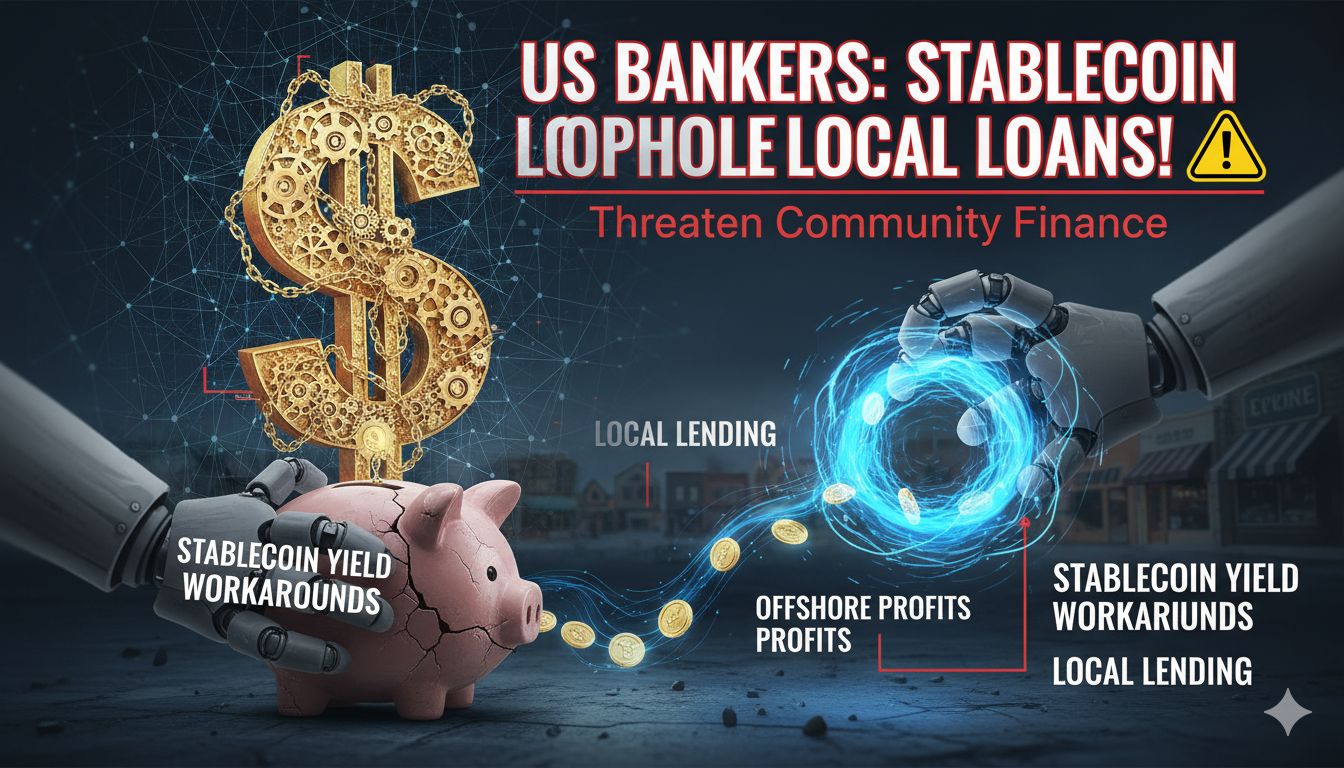
“US bankers are urgently calling on Congress to plug loopholes in recent stablecoin regulations, arguing that yield-bearing incentives offered by crypto platforms could drain trillions in deposits from community banks. This shift threatens to slash lending capacity by hundreds of billions, hurting small businesses, farmers, and homebuyers who rely on local credit for growth and stability.”
US Bankers Warn Stablecoin Yield Workarounds Threaten Local Lending
Unpacking the Stablecoin Loophole
Recent federal legislation aimed at regulating stablecoins, including provisions to prevent issuers from paying interest or yields directly to holders, has left gaps that crypto exchanges and affiliates are exploiting. These platforms offer reward programs tied to yield-generating activities, such as rehypothecation or speculative investments, effectively bypassing the rules. Bankers argue this turns stablecoins from simple payment tools into attractive investment vehicles, pulling funds away from traditional banking channels without the same regulatory safeguards.
Dire Consequences for Deposits and Lending
Industry analyses project severe disruptions if these workarounds persist. Community banks currently manage around $4.8 trillion in deposits, which support roughly $4 trillion in loans to vital sectors. Allowing yield incentives could trigger a $1.3 trillion drain on these deposits, leading to an $850 billion contraction in lending activity. This outflow stems from consumers and businesses shifting to higher-return stablecoin options, reducing the pool of funds available for community-oriented credit.
In moderate adoption scenarios, where stablecoins capture $500 billion in value with limited recycling back into banks, net deposit losses could reach $300 billion, amplifying lending cuts between $190 billion and $408 billion when factoring in liquidity constraints. High-adoption cases, especially if stablecoin issuers gain direct access to central bank facilities, might see $1 trillion in drains, slashing loans by up to $1.26 trillion. Such reductions would disproportionately affect small and medium enterprises, agricultural operations, and residential mortgages, stifling job creation and economic expansion in rural and underserved areas.
Risks to Financial Stability and Consumers
| Adoption Scenario | Projected Deposit Drain | Estimated Lending Reduction |
|---|---|---|
| Low (e.g., $200B stablecoin growth, high recycling) | $100 billion | $65 billion to $141 billion |
| Moderate (e.g., $500B growth, low recycling) | $300 billion | $190 billion to $408 billion |
| High (e.g., $1T growth, minimal banking ties) | $1 trillion | $600 billion to $1.26 trillion |
The shift toward uninsured stablecoin holdings exposes users to greater perils, as seen in past platform failures where holders ranked as unsecured creditors without federal deposit insurance. Banks, facing volatile wholesale deposit inflows from stablecoin reserves, must bolster liquidity buffers, further limiting credit extension. Higher funding costs—passed on to borrowers at rates exceeding 60%—could widen lending disparities, favoring large corporations with market access over local entities.
Bankers Rally for Regulatory Fixes
A coalition of national and state banking associations has mobilized, sending joint appeals to lawmakers to extend prohibitions on yields to all affiliates and partners of stablecoin issuers. Leaders emphasize restoring competitive balance, noting that unregulated platforms enjoy advantages by engaging in riskier practices barred for insured institutions. Without swift action, they warn, core banking functions like deposit-taking and community lending could face irreversible disintermediation.
Crypto Industry’s Pushback
Proponents from the digital asset sector counter that yield programs enhance competition in payments and do not inherently siphon deposits disproportionately. They point to banks’ own reserves earning interest at central facilities, arguing that bans on rewards could hinder innovation and regulatory progress in financial services.
Disclaimer: This article is for informational purposes only and does not constitute financial advice, investment recommendations, or endorsements. All information is based on publicly available reports and analyses.