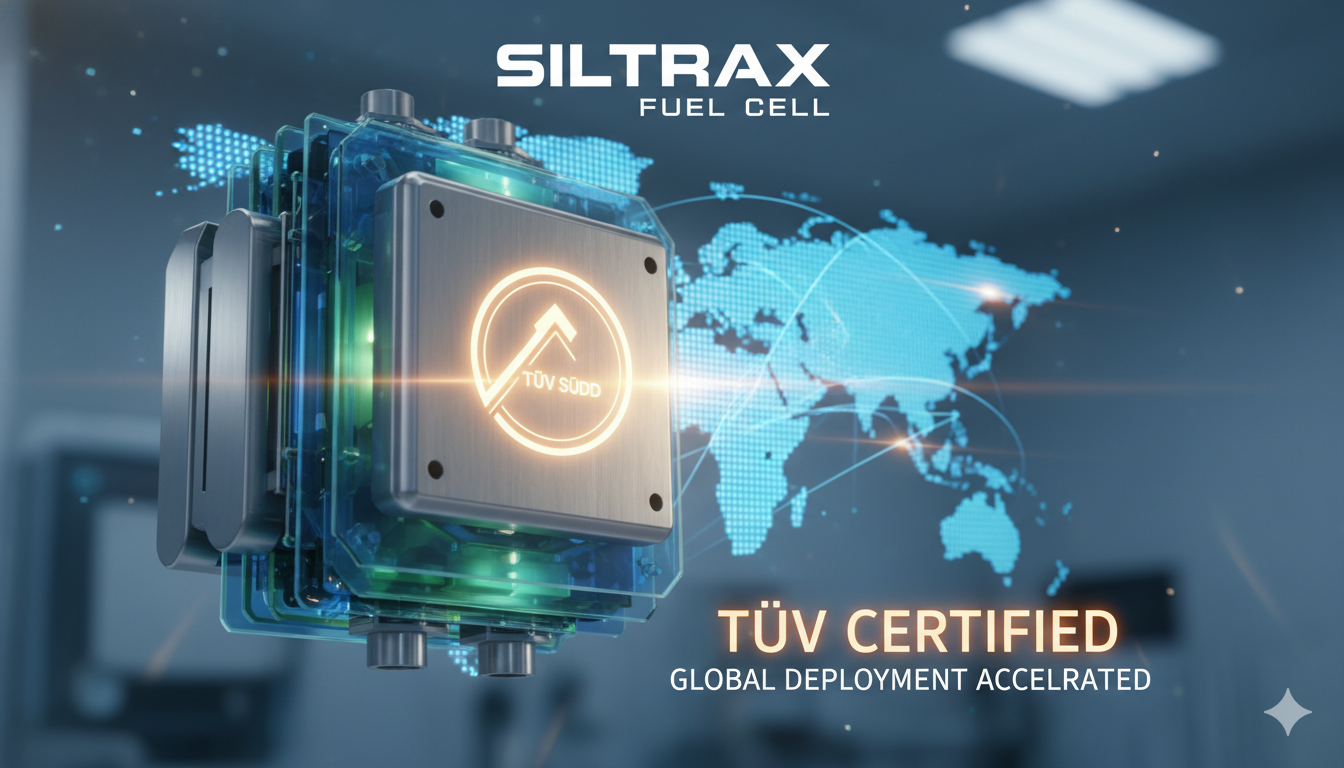
“Siltrax’s silicon-based G-100 PEM fuel cell stack has obtained TÜV certification, confirming compliance with IEC 62282-2-100 standards for safety, manufacturing reliability, and market readiness. This achievement follows record-breaking power densities of up to 9.77 kW/L volumetric and 9.7 kW/kg gravimetric, positioning the technology to drive faster integration in high-stakes sectors like aviation and heavy-duty transport, while reducing certification barriers for OEM partners.”
Technology Breakthrough in Silicon-Based Fuel Cells
Siltrax has pioneered a unique approach to proton exchange membrane (PEM) fuel cell design by incorporating silicon-based bipolar plates, a departure from traditional graphite or metal alternatives. This innovation leverages semiconductor-grade silicon, adapted from photovoltaic manufacturing processes, to create a stack that excels in compactness, efficiency, and durability. The G-100 model, rated at 150 kW, integrates micro-channel designs that enhance fluid dynamics and heat management, minimizing energy losses during operation.
Key advantages stem from the material’s properties: silicon’s high thermal conductivity helps dissipate heat evenly, reducing hotspots that can degrade performance over time. Structural rigidity ensures the stack withstands vibrations and mechanical stresses common in mobile applications. These features make the G-100 particularly suited for environments where weight and space are premium, such as unmanned aerial vehicles, marine vessels, and long-haul trucking fleets.
In practical terms, the stack’s architecture allows for modular scaling, enabling systems from 1 kW to multi-megawatt configurations without proportional increases in size or cost. Manufacturing draws on established solar industry supply chains, promising economies of scale that could lower unit costs by up to 40% compared to conventional fuel cells as production ramps up.
Certification Details and Compliance Standards
The TÜV certification validates the G-100’s adherence to IEC 62282-2-100, an international standard governing fuel cell safety and performance. This includes rigorous assessments of electrical isolation, pressure containment, and fault tolerance under extreme conditions. Testing covered scenarios like overvoltage, thermal runaway, and hydrogen leakage, ensuring the stack meets global regulatory thresholds for deployment.
For system integrators, this component-level certification streamlines the path to full product approvals. Instead of repeating exhaustive safety evaluations, partners can reference Siltrax’s validated data, potentially shortening development timelines by months. This is critical in regions with stringent environmental mandates, where hydrogen systems must demonstrate zero-emission compliance alongside operational safety.
The certification also aligns with emerging sustainability frameworks, emphasizing low-carbon production and recyclability. Silicon components facilitate easier disassembly and material recovery at end-of-life, supporting circular economy principles in clean energy hardware.
Applications and Sector-Specific Benefits
In aviation, the G-100’s gravimetric power density translates to lighter propulsion systems, allowing hybrid-electric aircraft to carry more passengers or cargo without sacrificing range. For instance, in regional jets, integrating such stacks could extend flight durations by 20-30% over battery-only alternatives, while emitting only water vapor.
Heavy transport benefits from the stack’s durability under high-load cycles. Truck fleets operating on hydrogen could achieve refueling times comparable to diesel, with the added advantage of silent, vibration-free power delivery. Marine applications, including ferries and cargo ships, leverage the compact design to fit within existing engine bays, facilitating retrofits that comply with IMO emissions regulations.
Off-grid power generation represents another key area, where the G-100 powers remote installations like telecom towers or mining operations. Its self-humidifying capabilities reduce water dependency, making it viable in arid environments. Small-scale hydrogen production integrations further enhance versatility, enabling on-site electrolyzer pairings for closed-loop energy systems.
Market Dynamics and Growth Projections
The hydrogen fuel cell sector is experiencing explosive expansion, fueled by global decarbonization efforts and investments in green infrastructure. Projections indicate robust growth across multiple segments, with stationary and transportation applications leading the charge.
| Segment | 2025MarketSize(USDBillion) | Projected2030MarketSize(USDBillion) | CAGR(2026-2030) |
|---|---|---|---|
| OverallFuelCellMarket | 5.66 | 18.16 | 26.3% |
| HydrogenFuelCellsforStationaryPower | 4.31 | 7.84 | 7.5% |
| LightweightHydrogenFuelCells | 0.058 | 0.096 | 7.4% |
| ProtonExchangeMembrane(PEM)Subsegment | 2.5(estimated) | 10.5(estimated) | 33.2%(approx.) |
These figures reflect increasing adoption driven by policy incentives, such as tax credits for zero-emission technologies and funding for hydrogen hubs. In the U.S., initiatives like the Hydrogen Shot aim to reduce clean hydrogen costs to $1 per kilogram, amplifying demand for efficient stacks like the G-100.
Siltrax’s milestone could catalyze further investments, as certified hardware lowers entry barriers for new entrants in supply chains. Broader market momentum includes partnerships between automakers and energy firms to build refueling networks, potentially adding thousands of stations by decade’s end.
Implications for U.S. Investors and Industry Players
For American audiences, this development underscores opportunities in the burgeoning clean energy landscape. The certification enhances Siltrax’s appeal to U.S.-based OEMs, potentially fostering collaborations in defense, logistics, and utilities. As hydrogen integrates into national energy strategies, companies positioned in the value chain stand to gain.
Sector stocks have shown resilience amid volatility, with real-time bids reflecting investor sentiment toward innovation milestones. Plug Power (PLUG) trades at a bid of 2.22, Ballard Power Systems (BLDP) at 2.57, FuelCell Energy (FCEL) at 8.92, and Bloom Energy (BE) at 150.5. These valuations suggest cautious optimism, with potential upside as certifications like Siltrax’s signal maturing technologies.
Key points for stakeholders:
Risk Mitigation: Certified components reduce project delays, appealing to venture capital and institutional funds eyeing hydrogen plays.
Competitive Edge: Silicon-based designs could disrupt incumbents reliant on scarcer materials, shifting supply dynamics.
Economic Ripple Effects: Accelerated deployment supports job creation in manufacturing and infrastructure, aligning with domestic reshoring trends.
Global Trade Considerations: U.S. exporters benefit from interoperable standards, expanding market access to Europe and Asia.
Overall, this certification marks a pivotal step, enabling Siltrax to transition from prototypes to commercial volumes, with sampling underway and full production slated for later phases.
Disclaimer: This news report is for informational purposes only and does not constitute financial advice, investment recommendations, or endorsements. Sources are based on publicly available industry data.