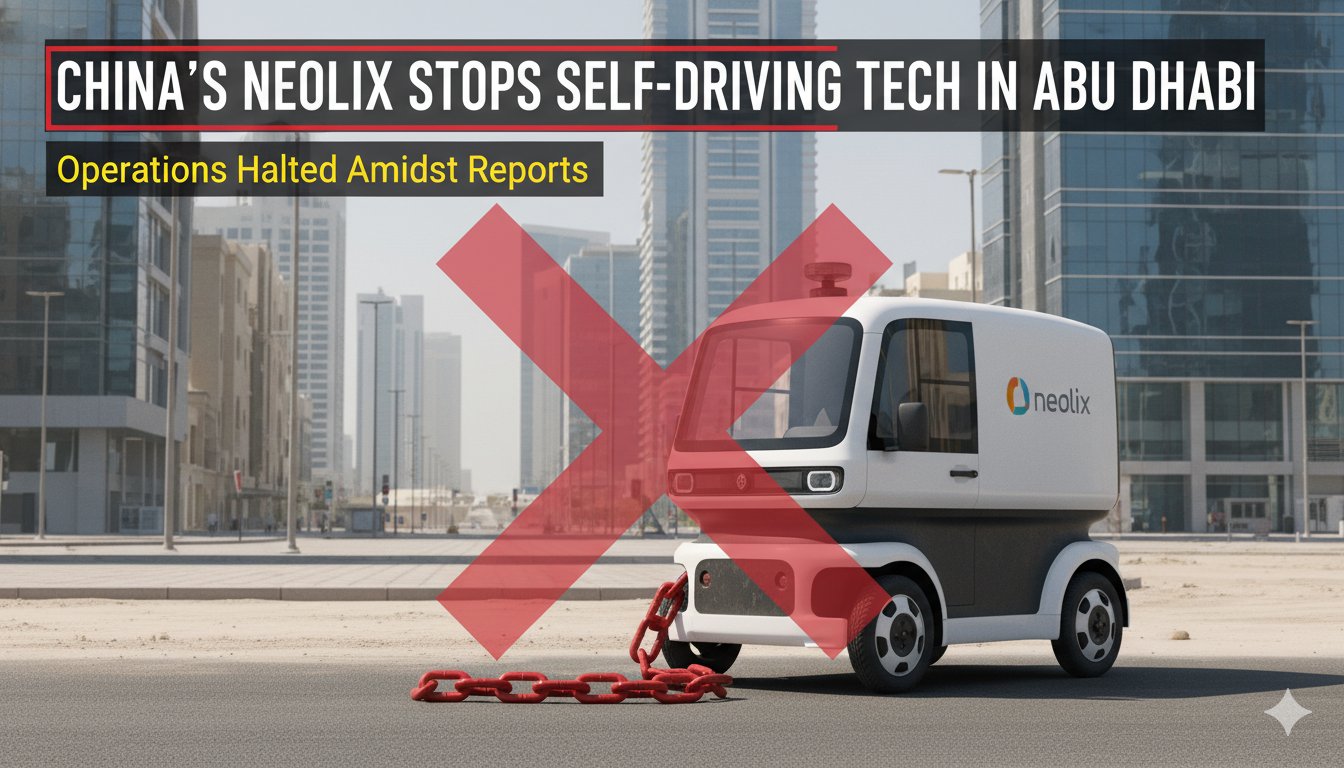
Chinese autonomous delivery specialist Neolix has temporarily halted its daily driverless vehicle operations in Abu Dhabi, citing compliance with local government directives and prioritizing personnel and asset safety. The suspension comes as the UAE grapples with spillover effects from the ongoing U.S.-Israel war with Iran, marking a setback for one of the region’s most ambitious smart mobility deployments by a Chinese firm. Neolix, which recently secured the Middle East’s first autonomous delivery license and deployed hundreds of RoboVans, plans to resume once conditions allow, highlighting how geopolitical risks can abruptly disrupt high-tech logistics initiatives in emerging markets.
Neolix’s Operational Pause in Abu Dhabi
Neolix, the Beijing-based leader in Level 4 autonomous delivery vehicles, known as RoboVans, has confirmed the temporary suspension of its autonomous delivery services in Abu Dhabi. The company stated that current operations in the city are on hold, with a clear emphasis on adhering to unified arrangements from local authorities while placing personnel and operational safety at the forefront.
This decision follows requirements from relevant UAE government departments, aimed at ensuring the protection of teams and assets during a period of heightened regional instability. Neolix has committed to ongoing dialogue with regulators and partners, with intentions to restart activities at the appropriate time when security conditions improve.
The halt arrives against a backdrop of significant prior momentum for Neolix in the UAE. In late 2025, the company obtained the Middle East’s inaugural license for fully unmanned autonomous delivery vehicle operations from Abu Dhabi Mobility (Integrated Transport Centre). This milestone enabled the launch of commercial pilots, including deployments in Masdar City, a hub for sustainable innovation.
Through a strategic alliance with K2 Group, an Abu Dhabi-based advanced technology firm specializing in AI and unmanned systems, Neolix positioned K2 as the local fleet operator. This partnership facilitated the integration of Neolix’s proven platforms into Abu Dhabi’s smart mobility framework, including adaptations for the region’s extreme desert climate, varied terrain, and specific regulatory needs.
Neolix delivered a total of 300 RoboVans to the UAE as part of its expansion push, contributing to pilots that demonstrated reliable last-mile logistics without human intervention. Globally, the firm has amassed over 100 million kilometers in autonomous operations, underscoring its scale in the robovan sector and its ambition to lead in urban logistics automation.
Broader Implications for Autonomous Mobility in the Gulf
The suspension is not isolated. Escalating tensions stemming from the U.S.-Israel involvement in conflict with Iran have prompted similar precautionary measures across the autonomous vehicle landscape in the region. Other Chinese players have faced disruptions: robotaxi services in Dubai have been paused by some operators, while testing and deployments in nearby hubs have been adjusted or halted to align with local security protocols.
For instance, certain firms have suspended fleets or testing in Dubai pending further guidance, even as operations in Abu Dhabi and Riyadh continue for others. These moves reflect a common priority—safety amid drone threats, missile exchanges, and broader instability that has impacted logistics infrastructure across the Gulf.
The UAE has aggressively courted Chinese autonomous tech firms to bolster its vision of becoming a global leader in smart cities and future mobility. Abu Dhabi, in particular, has issued licenses for fully driverless commercial operations to multiple Chinese entities, including robotaxi and delivery providers. Neolix’s entry aligned with this strategy, leveraging the emirate’s supportive regulatory environment to validate and scale technology beyond China’s domestic market.
Neolix’s ambitions in the region were substantial. Plans outlined included deploying up to 5,000 autonomous vehicles in the UAE by the end of 2026, with projections for annual overseas sales reaching 5,000 to 10,000 units by 2027. The Middle East was positioned as a key bridgehead for international growth, followed by pilots in Europe, Northeast Asia, Southeast Asia, and beyond.
Geopolitical Risks and Investment Backdrop
This pause illustrates the vulnerability of capital-intensive autonomous deployments to external shocks. The UAE’s push into autonomous logistics and mobility has attracted significant investment, including from sovereign-linked entities. Neolix itself benefited from a record-breaking Series D round exceeding $600 million in 2025, led by UAE-based Stone Venture alongside prominent Chinese and international investors. Such funding has fueled fleet expansion and technological refinement, including AI-driven dispatch systems and visual algorithms tailored for complex environments.
However, the current conflict dynamics introduce uncertainty. Disruptions to logistics bases, heightened security protocols, and potential infrastructure impacts could delay commercialization timelines. For investors tracking the autonomous sector, this event serves as a reminder that while regulatory friendliness and funding flows enable rapid scaling, geopolitical stability remains a critical variable in overseas markets.
Neolix’s response has been measured and compliant, focusing on safety without signaling a full withdrawal. The company continues to emphasize communication with stakeholders and readiness to resume, suggesting the suspension is viewed as temporary rather than structural.
Key Milestones in Neolix’s UAE Journey
Secured Middle East’s first autonomous delivery vehicle operation license in 2025.
Launched commercial pilot in Masdar City.
Partnered with K2 Group for local operations and fleet management.
Delivered 300 RoboVans to the UAE.
Accumulated global operational data exceeding 100 million kilometers.
As the situation evolves, market observers will watch closely for resumption signals and any adjustments to deployment strategies in the Gulf. The episode highlights both the promise of autonomous logistics in forward-looking markets like the UAE and the real-world challenges of implementing cutting-edge technology amid unpredictable regional dynamics.
Disclaimer: This is a news report based on current developments in the autonomous vehicle sector. It is for informational purposes only and does not constitute investment advice, financial recommendation, or endorsement of any company or technology.