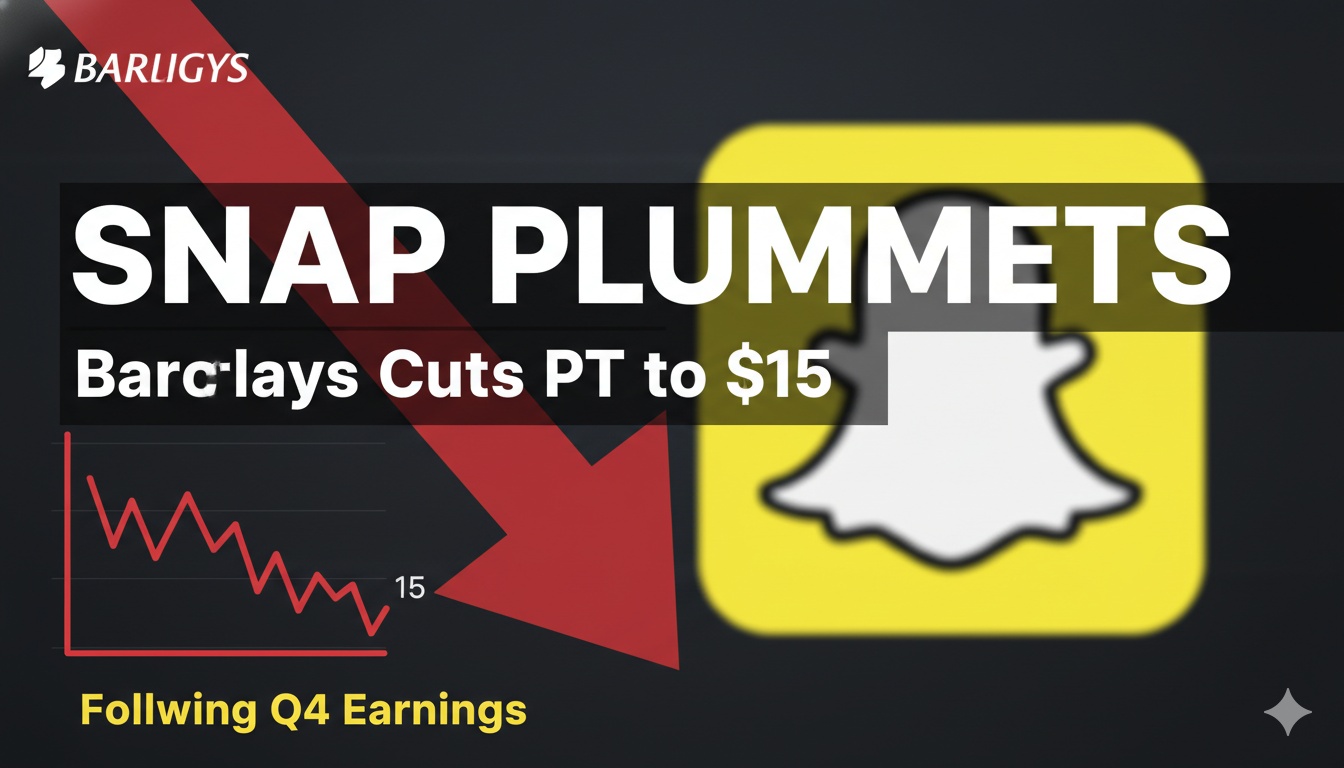
Barclays has reduced its price target for Snap Inc. from $16 to $15 while maintaining an Overweight rating, citing a fluctuating outlook for the company amid lagging core advertising business and regulatory challenges. Snap’s fourth-quarter results showed revenue growth of 10% to $1.72 billion and a shift to net income of $45 million, but shares have declined sharply as analysts adjust expectations downward.
Barclays Adjusts Snap Valuation Post-Earnings
In the wake of Snap Inc.’s latest quarterly performance, Barclays has revised its assessment of the social media company’s stock, dropping the price target to $15 from a previous $16. Despite the cut, the firm upholds an Overweight rating, signaling continued confidence in potential upside through strategic initiatives. Analysts point to an evolving narrative for Snap, where core advertising operations are underperforming relative to peers, compounded by regulatory pressures in key markets like North America and Europe. This adjustment reflects a broader recalibration among Wall Street firms, as Snap navigates a competitive landscape dominated by larger platforms investing heavily in AI and user engagement tools.
Snap’s fourth-quarter financials revealed a mixed bag of progress and persistent hurdles. The company reported total revenue of $1.72 billion, marking a 10% increase from the same period last year. This growth was driven primarily by diversification efforts, including expansions in subscription services and augmented reality features. Net income swung to a positive $45 million, a significant improvement from the $9 million recorded in the prior year’s quarter, underscoring operational efficiencies and cost controls. Adjusted EBITDA climbed to $358 million, up from $276 million, with gross margins expanding to 59%—a 4 percentage point sequential rise and 2 points year-over-year.
| Financial Metric | Q4 2025 | Q4 2024 | Year-Over-Year Change |
|---|---|---|---|
| Revenue | $1.72B | $1.56B | +10% |
| Net Income | $45M | $9M | +400% |
| Adjusted EBITDA | $358M | $276M | +30% |
| Gross Margin | 59% | 57% | +2 pts |
| Operating Cash Flow | $270M | N/A | N/A |
| Free Cash Flow | $206M | N/A | N/A |
The earnings beat consensus estimates on several fronts, with revenue edging past the anticipated $1.70 billion and earnings per share coming in at $0.03 against expectations of a slight loss. However, investor sentiment soured due to forward guidance that highlighted uncertainties in advertising demand and user growth metrics. Snap’s global monthly active users reached 946 million, but daily active users showed signs of stagnation in mature markets, prompting concerns about retention amid intensifying competition from rivals offering more integrated AI experiences.
Key Drivers Behind the Price Target Revision
Barclays’ decision to lower the target stems from several interrelated factors. Foremost is the sluggish performance in Snap’s foundational advertising segment, which constitutes the bulk of its revenue stream. While the company has made strides in direct response advertising and partnerships with third-party AI firms, broader economic headwinds—such as fluctuating digital ad spend in consumer goods and entertainment sectors—have dampened momentum. Analysts noted that Snap’s ad business is “lagging” behind industry benchmarks, with impressions growth not fully translating into monetization gains.
Regulatory overhangs add another layer of complexity. Snap faces scrutiny in multiple jurisdictions over data privacy practices, content moderation, and antitrust issues related to its augmented reality ecosystem. In the U.S., ongoing debates around app store policies and youth protection laws could impose additional compliance costs, potentially eroding margins. European regulators have similarly ramped up investigations into platform algorithms, which might necessitate changes to Snap’s core features like Stories and Spotlight.
Despite these challenges, Barclays sees “call options” in Snap’s pipeline. The firm’s Overweight stance hinges on emerging opportunities in subscriptions and hardware. Snap+ subscriptions surged to 24 million users, contributing to revenue diversification and providing a more predictable income base. Investments in augmented reality glasses and AI-enhanced content creation tools are viewed as long-term growth catalysts, potentially positioning Snap as a leader in immersive social experiences. Analysts project that these initiatives could offset advertising volatility, with full-year 2025 revenue hitting $5.93 billion, an 11% rise from the previous year.
Broader Analyst Sentiment and Market Reaction
The Barclays move aligns with a wave of post-earnings adjustments from other major firms, reflecting a consensus shift toward caution. For instance, some analysts have slashed targets more aggressively, citing missed opportunities in user engagement and partnerships. One firm reduced its target to $5.50 while downgrading to Sell, emphasizing that first-quarter 2026 revenue guidance fell short due to unmaterialized deals. Others maintained Neutral ratings but trimmed valuations to between $6 and $7, highlighting risks from economic slowdowns and competitive pressures.
Snap’s stock has reacted volatilely, trading around $5.22 in recent sessions—a level that implies a substantial discount to Barclays’ $15 target. This pricing suggests market skepticism, with shares down significantly from their 52-week high of $11.26. Trading volume spiked post-earnings, reaching over 90 million shares in a single day, as investors digested the implications. The company’s market capitalization hovers near $9 billion, with a price-to-earnings ratio reflecting ongoing losses on a trailing basis but improving prospects for 2026.
Strategic Pivots and Future Outlook
| Analyst Firm | Rating | New Price Target | Previous Target | Change |
|---|---|---|---|---|
| Barclays | Overweight | $15 | $16 | -6% |
| Stifel | Sell | $5.50 | $7 | -21% |
| Guggenheim | Neutral | $6.50 | $8.50 | -24% |
| Canaccord | Hold | $7 | $9 | -22% |
| Rosenblatt | Neutral | $6.40 | $9.50 | -33% |
Snap’s management has emphasized a pivot toward profitable growth, evidenced by a $500 million stock repurchase authorization aimed at offsetting dilution from employee stock units. This move leverages the company’s solid balance sheet, with $2.9 billion in cash and equivalents as of year-end. Operational efficiencies, including a 10% workforce reduction earlier in the year, have contributed to margin expansion and positive free cash flow.
Looking ahead, Snap is betting on AI integrations and hardware innovations to reignite user growth. Partnerships for AI-driven search and content personalization are expected to enhance platform stickiness, particularly among younger demographics. However, execution risks remain, as larger competitors continue to dominate ad budgets and user time. Analysts like those at Barclays anticipate that successful scaling of these efforts could drive revenue per user higher, potentially justifying the Overweight view despite near-term headwinds.
Competitive Landscape and Industry Trends
Within the broader social media sector, Snap’s challenges mirror industry-wide shifts. Advertising budgets are increasingly concentrated on platforms with proven AI capabilities and e-commerce integrations. Snap’s focus on ephemeral content and AR sets it apart but has yet to fully capitalize on these differentiators at scale. Peers have reported varying degrees of ad recovery, with some benefiting from economic rebounds in retail and gaming sectors.
Economic indicators suggest cautious optimism for 2026, with potential interest rate cuts spurring ad spend. However, geopolitical tensions and inflation could prolong uncertainty. For Snap, balancing innovation with cost discipline will be crucial, as evidenced by its full-year net loss narrowing to $460 million from prior periods.
Financial Health and Valuation Metrics
Snap’s financial position remains resilient, with operating cash flow at $270 million for the quarter. The company’s debt levels are manageable, supporting investments in R&D. Valuation-wise, the stock trades at a forward price-to-sales multiple below historical averages, appealing to value-oriented investors. Barclays’ $15 target implies roughly 187% upside from current levels, predicated on achieving mid-teens revenue growth and sustained margin gains.
In summary, while the price target cut signals tempered expectations, it underscores a belief in Snap’s underlying potential amid a transitional phase.
Disclaimer: This news report is for informational purposes only and does not constitute financial advice, investment tips, or endorsements. All information is based on publicly available data from reliable sources, but accuracy is not guaranteed.