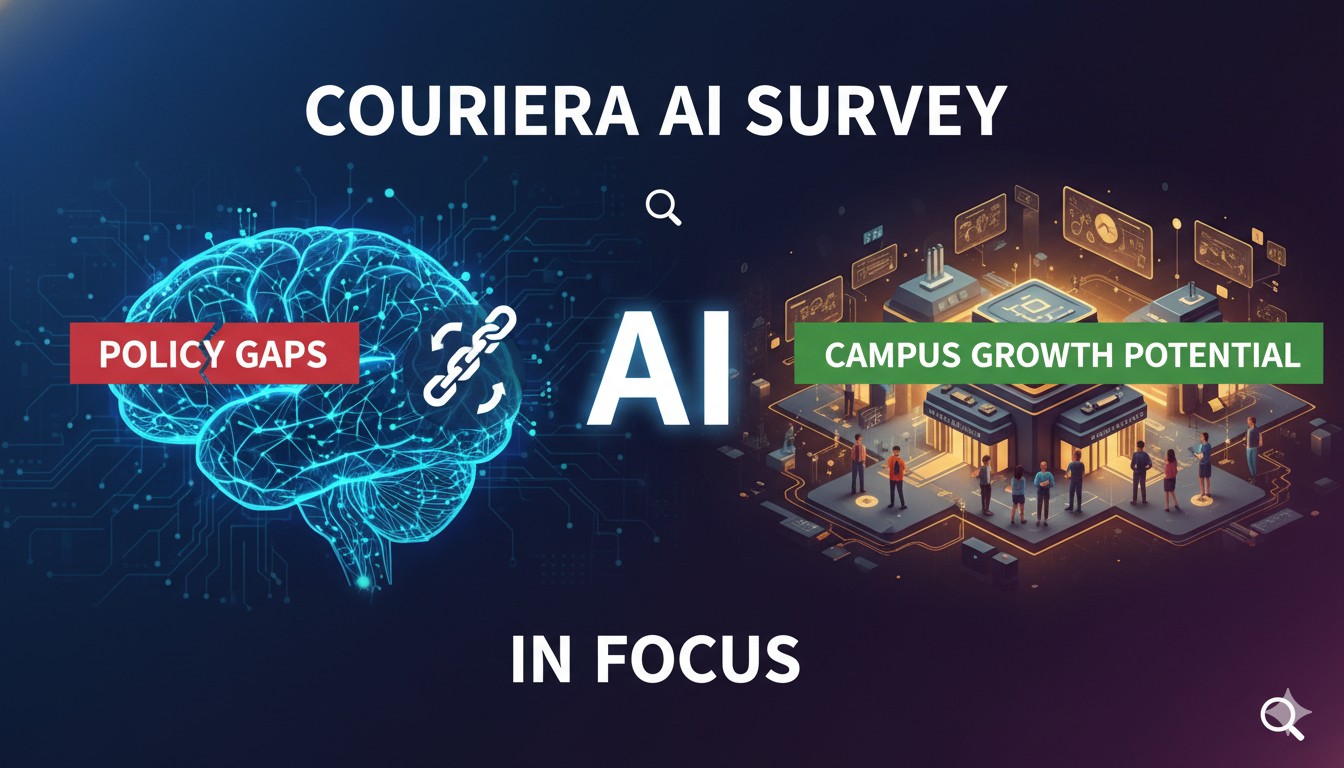
**” A recent Coursera survey of over 4,200 students and educators across key markets reveals near-universal AI adoption in higher education, with 95% using AI tools for learning and teaching. While 81% globally—and 78% in the U.S.—view AI’s impact positively, including improved academic performance for four in five students, significant gaps persist: only about one-quarter of educators feel prepared to use AI effectively, just 26% of institutions have formal policies, and half of U.S. respondents see the higher education system as unprepared to manage AI’s rise. These findings highlight both the explosive growth potential for AI-enhanced campuses and the urgent need to address policy, training, and governance shortcomings. “**
Coursera AI in Higher Education Report Highlights Adoption Surge Amid Preparedness Concerns
The latest insights from Coursera’s comprehensive survey underscore a transformative moment for U.S. higher education. With AI tools now integral to daily academic life, students and faculty are leveraging them for personalized learning experiences, instant feedback mechanisms, and boosted efficiency in research and coursework. Yet this rapid integration has outpaced institutional frameworks, creating a landscape where enthusiasm for AI’s benefits collides with worries over readiness and oversight.
Nearly all surveyed participants—95% of students and educators—report active use of AI in educational contexts. This marks a profound shift, as generative AI and related technologies enable tailored study aids, automated grading support, and enhanced productivity. In the U.S., students in particular note tangible gains: four in five report that AI has directly improved their academic performance, helping them grasp complex concepts faster, refine writing, and manage workloads more effectively.
Positive perceptions dominate, with 78% of U.S. students and educators agreeing that AI exerts a beneficial influence on higher education overall. This optimism stems from AI’s ability to democratize access to high-quality resources, support diverse learning styles, and free up time for deeper critical thinking and human interaction. Globally, the figure climbs to 81%, reflecting even stronger endorsement in markets like India and the UK, where adoption rates for certain tasks have surged dramatically.
Despite these advantages, a clear divide emerges in confidence levels. Only 25% of faculty worldwide feel they and their peers possess the necessary skills to harness AI advantageously. This personal skills gap translates into broader institutional concerns. In the U.S., 50% of respondents believe the higher education system remains unprepared to handle AI’s expanding role. Globally, 56% share similar doubts about systemic readiness, while 52% of educators think their national higher education frameworks fall short.
Governance represents one of the most glaring deficiencies. Just 26% of institutions globally have implemented a formal policy to regulate AI use in teaching, assessment, and research. In the U.S., this drops further to only 20% of universities with such guidelines in place. Even fewer—28% worldwide—express belief that their own institution is equipped to manage student AI usage responsibly. Without clear policies, campuses risk inconsistencies in academic integrity standards, uneven application of tools, and potential erosion of trust in evaluation processes.
These policy voids contrast sharply with the on-the-ground reality of widespread experimentation. Students are incorporating AI into roughly 44% of their study tasks globally, with U.S. figures at 38%. Faculty engagement is also substantial, with many using AI heavily for curriculum development, lesson planning, and providing real-time student support. The survey points to AI’s role in fostering more inclusive education, such as by offering multilingual explanations or adaptive tutoring that addresses individual gaps.
The growth potential for campuses is immense. Institutions that invest in faculty development programs, ethical AI guidelines, and infrastructure for responsible integration stand to gain a competitive edge. AI can amplify human-led instruction rather than replace it, enabling professors to focus on mentorship, complex problem-solving, and fostering creativity. Early movers could see enhanced student outcomes, higher retention rates, and stronger alignment with workforce demands for AI-literate graduates.
However, the survey warns that without deliberate action, these opportunities may be undermined by risks like over-reliance on AI for core cognitive work, plagiarism concerns, or widening inequities if access to premium tools varies. U.S. respondents show slightly higher negative views compared to some international peers, possibly reflecting greater scrutiny of AI’s implications for academic rigor and equity.
To bridge these gaps, experts emphasize the need for transparent policies that outline acceptable uses while encouraging innovation. Faculty training initiatives, collaborative research on AI’s pedagogical impact, and partnerships with platforms offering AI literacy courses could accelerate progress. As AI evolves rapidly, universities that prioritize both capability-building and confidence-building will be best positioned to lead in an increasingly tech-augmented educational environment.
Disclaimer: This is a news and analysis report based on industry surveys and trends. It is for informational purposes only and does not constitute financial, investment, or professional advice.