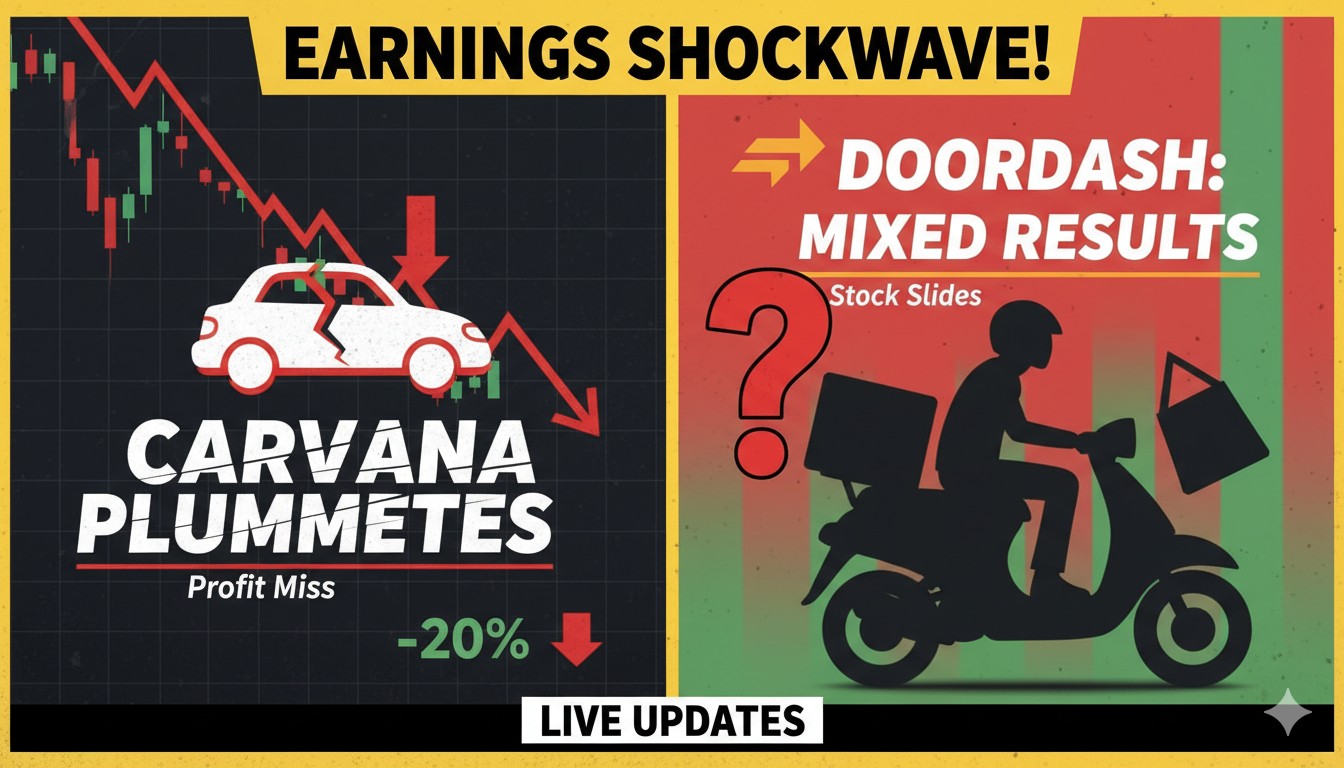
Carvana’s shares tumbled sharply following its Q4 2025 earnings report, as adjusted EBITDA fell short of Wall Street expectations despite a strong revenue beat and record unit sales. DoorDash also faced investor disappointment with a slight miss on revenue and earnings, though robust order growth and an optimistic outlook helped temper the initial decline, leading to a rebound in premarket trading. Both companies highlighted operational strengths in a challenging consumer environment, but profitability concerns weighed heavily on sentiment.
Carvana Faces Sharp Sell-Off on Profitability Concerns Despite Record Growth
The online used-car retailer Carvana delivered a mixed bag in its fourth-quarter 2025 results, released after market close on February 18. Revenue surged 58% year-over-year to $5.603 billion, comfortably exceeding analyst expectations around $5.27 billion. This top-line strength was driven by robust demand, with retail units sold reaching a record 163,522 for the quarter, up 43% from the prior year and beating estimates of approximately 157,226.
However, the market focused on the bottom line, where key profitability metrics disappointed. Adjusted EBITDA came in at $511 million, missing consensus forecasts of $535.7 million, resulting in an adjusted EBITDA margin of 9.1% compared to anticipated levels near 10.4%. Retail gross profit per unit stood at $3,076, reflecting a decline attributed to higher-than-expected reconditioning costs, elevated non-vehicle expenses, and industry-wide depreciation pressures. The company also cited lower shipping fee revenue as a contributing factor.
Net income for the quarter reached $951 million, boosted significantly by non-cash items including a substantial release of valuation allowances on deferred tax assets. Excluding these benefits, underlying profitability pressures were evident, contributing to investor unease. Full-year 2025 results were impressive overall, with retail units sold at 596,641 (up 43%), revenue of $20.322 billion (up 49%), and adjusted EBITDA of $2.237 billion, marking new records.
Guidance for 2026 emphasized continued profitable growth, with expectations for sequential increases in retail units and adjusted EBITDA starting in the first quarter. However, the outlook lacked detailed specifics on margin expansion or cost controls, which some investors viewed as vague amid rising operational challenges. This combination triggered a steep reaction, with shares plunging as much as 20% in after-hours trading and continuing to decline in premarket, erasing a portion of recent gains.
Carvana’s performance underscores the ongoing recovery in the used-vehicle market, fueled by its digital-first model and improved inventory management. Yet, the miss highlights persistent cost headwinds in reconditioning and logistics, even as the company scales toward its long-term ambition of 3 million annual retail units with a 13.5% adjusted EBITDA margin.
DoorDash Delivers Mixed Q4 Results, Stock Slides Before Rebounding on Guidance
Food delivery leader DoorDash reported fourth-quarter 2025 results that showed solid growth but fell slightly short of elevated Wall Street targets. Revenue reached $3.96 billion, up 38% year-over-year (or 26% excluding recent acquisitions like Deliveroo), but missed consensus estimates of around $4.0 billion. Adjusted earnings per share came in at $0.48, below the expected $0.55 to $0.59 range, reflecting GAAP net income strength offset by operational investments.
On the positive side, total orders and gross order value grew robustly, with marketplace gross order value increasing 39% to $29.7 billion. Adjusted EBITDA improved to $780 million, slightly beating expectations of $773.6 million, demonstrating improved profitability with a 19.7% margin. The company highlighted strong consumer engagement, particularly in core delivery categories, and continued expansion into new verticals and international markets.
Shares initially slipped in after-hours trading, dropping as much as 8-9% as investors digested the top- and bottom-line misses. However, an upbeat first-quarter outlook, including expectations for higher-than-anticipated gross order value, sparked a reversal, with the stock rebounding sharply in premarket sessions. This recovery reflects confidence in DoorDash’s ability to navigate competitive pressures while driving efficiency gains and order momentum.
The results illustrate DoorDash’s resilience in a maturing on-demand delivery sector, where user retention and order frequency remain key drivers. While near-term profitability fell short, the company’s focus on operational leverage and diversified revenue streams positions it well for sustained expansion.
Key Takeaways from the Earnings Action
Carvana demonstrated explosive top-line momentum but saw investor confidence shaken by margin compression and a less detailed forward view.
DoorDash posted healthy growth across metrics, with the initial negative reaction giving way to optimism over forward guidance and profitability trajectory.
Both stocks remain volatile plays in their respective sectors, with Carvana sensitive to used-car economics and DoorDash tied to consumer spending patterns in food and convenience delivery.
Disclaimer: This is for informational purposes only and does not constitute investment advice, financial recommendations, or a solicitation to buy or sell securities. Market conditions can change rapidly, and past performance is not indicative of future results. Always conduct your own research or consult a qualified advisor.