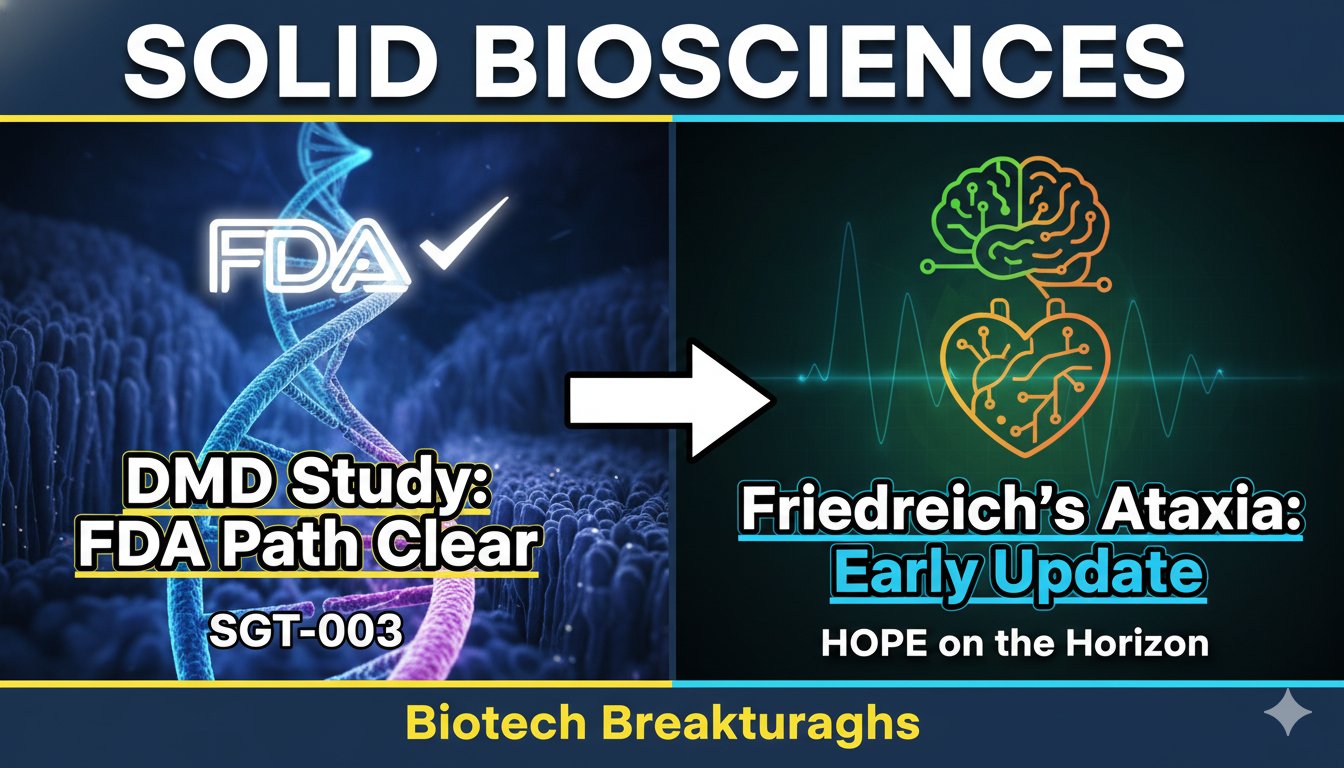
Solid Biosciences has secured key FDA alignment on the design of its pivotal Phase 3 IMPACT DUCHENNE trial for SGT-003, the company’s next-generation gene therapy candidate for Duchenne muscular dystrophy (DMD), paving the way for first participant dosing in Q1 2026 and potential accelerated approval discussions. The company also provided an early update on its Friedreich’s ataxia (FA) program with SGT-212, noting the recent dosing of the first patient in the Phase 1b FALCON trial and multiple FDA designations supporting advancement. These developments underscore Solid’s momentum in precision genetic medicines for rare neuromuscular diseases, with 36 participants dosed in the ongoing Phase 1/2 INSPIRE DUCHENNE study showing a favorable safety profile to date.
Solid Biosciences Advances Regulatory and Clinical Pathways for Neuromuscular Gene Therapies
Solid Biosciences continues to make significant strides in its mission to develop transformative gene therapies for rare neuromuscular and cardiac conditions. The company’s lead program, SGT-003 for DMD, has achieved a major regulatory milestone following a positive Type C meeting with the FDA. This alignment focuses on the overall design of the Phase 3 IMPACT DUCHENNE trial, a randomized, double-blind, placebo-controlled study evaluating the efficacy and safety of a single dose of SGT-003.
The IMPACT DUCHENNE trial is structured to serve as a registrational study, with plans to conduct it primarily at sites in Australia, Canada, the European Union, and the United Kingdom. Due to strong interest from key opinion leaders and the patient community, Solid is exploring the possibility of adding U.S. sites. The primary endpoint centers on functional measures such as time to rise from the floor, assessed over an approximately 18-month period. First participant dosing is anticipated in the current quarter, marking a swift transition from early-phase data to this pivotal stage.
In parallel, Solid is pursuing an accelerated approval pathway in the U.S. for SGT-003. The company plans multiple interactions with the FDA during the first half of 2026 to refine the confirmatory evidence required, including potential reliance on surrogate endpoints like micro-dystrophin expression levels and biomarkers of muscle and cardiac function. An update on these discussions is expected mid-year. This strategy reflects the urgent unmet need in DMD, where disease progression leads to loss of ambulation, respiratory complications, and cardiac issues in young patients.
Supporting this regulatory push is the ongoing Phase 1/2 INSPIRE DUCHENNE trial, which has now dosed 36 participants as of recent updates. SGT-003 utilizes the novel AAV-SLB101 capsid, engineered for enhanced targeting to skeletal and cardiac muscle while reducing liver exposure. This design contributes to improved biodistribution, with rapid clearance from the blood—approximately 90% by day 4 post-infusion—and roughly 20-fold higher cardiac expression compared to traditional AAV9 vectors. Manufacturing enhancements have achieved a high full-to-empty capsid ratio of about 75%, and the immunomodulation regimen has been refined to a steroid-only prophylactic approach starting three days before dosing.
Safety data from the INSPIRE DUCHENNE study remain encouraging, with no reported cases of drug-induced liver injury (DILI), myocarditis, atypical hemolytic uremic syndrome (aHUS), or thrombotic microangiopathy (TMA) to date. The therapy continues to be generally well tolerated, reinforcing confidence in its profile as the program advances.
Beyond DMD, Solid provided an early glimpse into its Friedreich’s ataxia program with SGT-212, a recombinant AAV-based gene replacement therapy designed to deliver a functional frataxin (FXN) gene. Unlike many FA candidates, SGT-212 employs a dual-route administration approach to address both neurological and cardiac manifestations of the disease, targeting the root cause of frataxin deficiency that leads to progressive ataxia, cardiomyopathy, and other symptoms.
The Phase 1b FALCON trial, a first-in-human study, has successfully dosed its first participant. Initial data from this trial are anticipated in the second half of 2026, contingent on enrollment progress. SGT-212 has secured multiple FDA designations, including Orphan Drug, Fast Track, and Rare Pediatric Disease status, which highlight its potential to fill a critical gap in FA treatment options where no disease-modifying therapies are currently approved.
These advancements position Solid Biosciences as a key player in the evolving landscape of gene therapy for rare diseases. The company’s pipeline also includes earlier-stage candidates for conditions like catecholaminergic polymorphic ventricular tachycardia and TNNT2-mediated dilated cardiomyopathy, all leveraging the proprietary AAV-SLB101 platform.
Key milestones ahead include:
First dosing in IMPACT DUCHENNE (Q1 2026)
Additional FDA meetings on accelerated approval for SGT-003 (1H 2026)
Mid-2026 update on confirmatory trial alignment and accelerated pathway
Additional data readout from INSPIRE DUCHENNE (mid-2026)
Initial FALCON data for SGT-212 (H2 2026)
With these steps, Solid aims to deliver meaningful therapeutic options to patients facing these devastating conditions.
Disclaimer: This article is for informational purposes only and does not constitute investment advice, medical advice, or a recommendation to buy or sell any securities. The information presented is based on publicly available data and should not be relied upon as the sole basis for any decision.